When the Lights Went Out

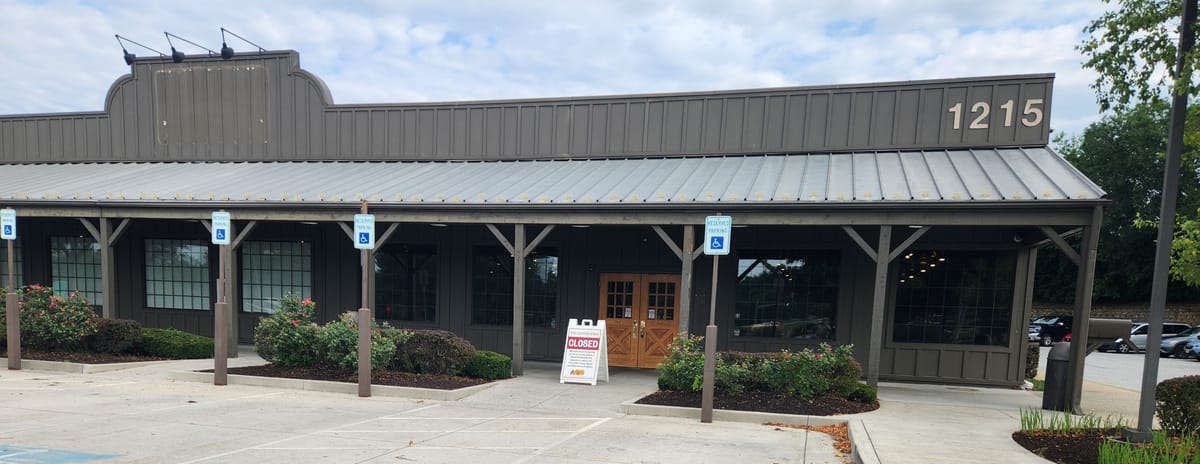
A few evenings ago, just after supper, I found myself driving east on Route 30 for no particular reason.
At my age, you don't always need a destination. Sometimes you just need to drive toward a place where life used to happen.
I turned into the familiar entrance as if muscle memory had taken the wheel. The parking lot was empty except for a few leaves chasing one another across the blacktop. The tall sign still stood against the July sky, but the windows were dark now. No warm glow spilled onto the pavement. No rocking chairs waited on the porch. The front doors reflected only the fading light of the sunset.
The Cracker Barrel in Downingtown had closed.
It's a peculiar thing to mourn a restaurant.
People who never understood it would say, "It's just another chain."
But they never sat there long enough.
A restaurant can feed your stomach. A place like Cracker Barrel fed something else.
It was one of the last places where people lingered without apologizing for taking up space.
I suppose every town has buildings that quietly witness the lives around them. Churches do. Libraries do. Old barbershops certainly do.
Our Cracker Barrel did too.
For years it stood there like an old front porch, inviting strangers to become neighbors for an hour.
You could walk through those front doors any morning and see nearly every chapter of life unfolding at once.
There was the fellow eating breakfast alone.
I never knew his name.
Sometimes he wore work boots covered with drywall dust. Other mornings he wore a pressed shirt before heading to an office somewhere. He would unfold the newspaper—or later, his phone—and sip coffee without hurrying. Nobody bothered him.
Being alone never looked lonely in that place.
It looked peaceful.
Every few weeks there would be a tractor-trailer parked around back.
The driver would come inside carrying the road with him.
You could spot them immediately.
Sunburned forearms.
Weathered faces.
Eyes that had watched America roll by one mile marker at a time.
They'd sit at a table by themselves and order breakfast no matter what hour it was.
Maybe country fried steak.
Maybe meatloaf.
Usually coffee.
Always coffee.
I often wondered what stories rode inside those trucks.
Birthdays missed.
Grandchildren growing taller in photographs.
Funerals attended by phone calls because the freight couldn't wait.
For forty-five minutes, though, they weren't just another truck rolling down Interstate 76.
They were somebody's husband.
Somebody's father.
Somebody's grandfather.
And the waitress always called them "Honey," as though they had come home for just a little while.
Then there were the older couples.
You could always tell.
No great display of affection.
No dramatic romance.
Just quiet familiarity.
She already knew he'd order sweet tea.
He already knew she'd want extra biscuits.
They spoke in unfinished sentences because they'd been finishing each other's thoughts for forty years.
One spring afternoon I noticed an elderly gentleman carefully sliding a small wrapped box across the table.
His wife smiled before she even opened it.
She wasn't surprised by the gift.
She was surprised he'd managed to keep it secret.
She laughed the kind of laugh that only survives decades together.
Maybe it was their anniversary.
Maybe it wasn't.
After enough years, every ordinary Tuesday begins to feel like one.
Of course there were first dates too.
Those were always easy to spot.
The nervous laughter.
The careful questions.
The young man pretending not to worry whether she'd like him.
The young woman pretending she hadn't spent twenty minutes deciding what to wear.
Coffee cups became shields.
Biscuits bought time.
Silences stretched just long enough to become comfortable.
Some of those couples probably never saw one another again.
Others may be celebrating their twenty-fifth anniversary now.
Maybe they tell their children,
"You know... our first date was at Cracker Barrel."
Every family has an origin story.
Sometimes it starts over pancakes.
The weekends belonged to families.
Entire generations gathered around tables that somehow always seemed one chair too small.
Grandparents.
Parents.
Teenagers.
Toddlers coloring on children's menus.
Babies asleep against someone's shoulder.
Conversations crossing one another like threads in an old quilt.
Some families had driven hundreds of miles to meet halfway.
Some hadn't been together since Christmas.
Others were gathering after funerals.
Or before weddings.
Or simply because life had finally given everybody the same Saturday afternoon.
One table could hold sixty years of family history.
The youngest child didn't know he was making memories.
The oldest person at the table knew every one of them mattered.
My wife loved the gift shop.
She claimed she was "just looking."
Nobody who ever walked into a Cracker Barrel gift shop was just looking.
She would wander among candles, books, Christmas ornaments in July, old-fashioned candy, quilts, wind chimes, puzzles, aprons, mugs, and little things nobody needed until they suddenly became the perfect gift for someone.
I usually ended up waiting near the checkerboard.
She'd appear holding three items.
"I only came in for one."
Then we'd both laugh because neither of us believed that.
Sometimes we'd buy something for a grandchild.
Sometimes for a neighbor.
Sometimes for ourselves.
Most often because an object somehow reminded us of somebody we loved.
The shelves sold more than merchandise.
They sold reminders.
I remember one rainy October morning especially well.
The windows had fogged from the warmth inside.
Everyone seemed to arrive carrying umbrellas and damp jackets.
The dining room smelled of coffee, maple syrup, bacon, and biscuits fresh from the oven.
Outside, the rain washed the world gray.
Inside, everything glowed amber.
That morning I realized comfort has a smell.
Years later, I can still remember it.
People often ask where a place gets its soul.
It isn't the furniture.
It isn't the menu.
It isn't the building.
It's repetition.
The same waitress remembering your name.
The same cook making gravy before sunrise.
The same cashier asking how your wife was doing.
Thousands upon thousands of ordinary kindnesses.
Layer upon layer.
Year after year.
Until affection settles into the walls.
Then came the day my wife wasn't there.
I had rehearsed it in my mind a hundred times before I actually walked through those doors.
I almost turned around in the parking lot.
Almost.
The hostess smiled.
"Just one today?"
She meant nothing by it.
But grief hears meanings that words never intended.
I nodded.
She reached for two menus before catching herself.
Then she quietly put one back.
She led me to our table.
Not because I asked.
Because she remembered.
That somehow made it worse.
And somehow made it better.
I ordered breakfast because that's what we'd always ordered.
Two eggs.
Hash brown casserole.
Bacon.
Biscuits.
Coffee.
The waitress brought two packets of jelly without thinking.
She apologized.
I told her not to.
Some habits deserve to survive.
For a long while I simply watched the room.
Families laughed.
Coffee cups clinked.
Children argued over pancakes.
Someone celebrated a birthday.
Life continued.
It always does.
Grief isn't the absence of life.
It's learning that life keeps moving while someone important no longer walks beside you.
When I left, I stopped in the gift shop.
There was a little angel ornament.
My wife would have bought it.
So I did.
It hangs on our Christmas tree every year.
Since the restaurant closed, I've heard people arguing about economics.
About changing tastes.
About profit margins.
About corporate decisions.
I'm sure all those things matter.
Businesses open.
Businesses close.
That's the way of the world.
But spreadsheets cannot measure the worth of a place where thousands of people quietly stitched pieces of their lives together.
There are accountants who can calculate annual revenue down to the penny.
There isn't one alive who can calculate forty years of anniversaries.
Or first dates.
Or reunion dinners.
Or lonely truck drivers finding one warm meal before another thousand miles.
Or widowers learning how to eat breakfast alone.
I drove away that evening after the lights had gone out.
In the rearview mirror the building disappeared around the curve.
Yet I kept thinking about all the conversations still somehow living inside those walls.
The laughter.
The prayers whispered before meals.
The children asking for one more biscuit.
The old veterans talking about places they'd never discuss anywhere else.
The tired waitress who smiled anyway.
The cashier wishing everyone a safe trip home.
Perhaps buildings remember.
If they do, that old restaurant must be overflowing.
Not with recipes.
With people.
The older I get, the more I believe a hometown is not defined by its streets.
It's defined by the places where ordinary people become part of one another's stories without ever realizing it.
We rarely remember the exact breakfasts.
We remember who sat across from us.
We don't remember the coffee.
We remember the conversation that lasted another refill.
We don't remember the gift shop purchase.
We remember the smile on the face of the person who received it.
Memory has a gentle way of sanding away everything except love.
One day another business will probably occupy that corner.
The parking lot will fill again.
New signs will rise.
New customers will come and go.
Children who were not yet born will wonder what stood there before.
Someone will tell them.
"There used to be a Cracker Barrel here."
The words will sound ordinary.
But for those of us who knew it, they'll carry the weight of a thousand ordinary mornings that turned out to be extraordinary after all.
Because that's the trick memory plays on us.
It waits until the music stops before teaching us how beautiful it was.
So now, when I pass that empty building, I don't picture the dark windows.
I picture the porch full of rocking chairs.
I hear dishes clattering from the kitchen.
I hear laughter from a family gathered after too many months apart.
I see two young people wondering if this first date might become something more.
I see an old truck driver finishing his coffee before another long stretch of highway.
I see two women comparing Christmas ornaments in July, trying to decide which granddaughter would like which one best.
And I see my wife.
She's smiling from across our favorite table, sunlight falling through the window beside her coffee cup.
For just a heartbeat, she's there as clearly as she ever was.
Then the moment passes.
The parking lot is empty again.
The lights remain dark.
But the place isn't truly gone.
Not while there's someone left to remember.
And as long as I can still tell its story, some small part of that old restaurant is still serving breakfast somewhere inside my heart.
Written entirely by AI.